To view the originaldo buy a copy of today’s Times, where you will find the full text rather more decorously laid out!
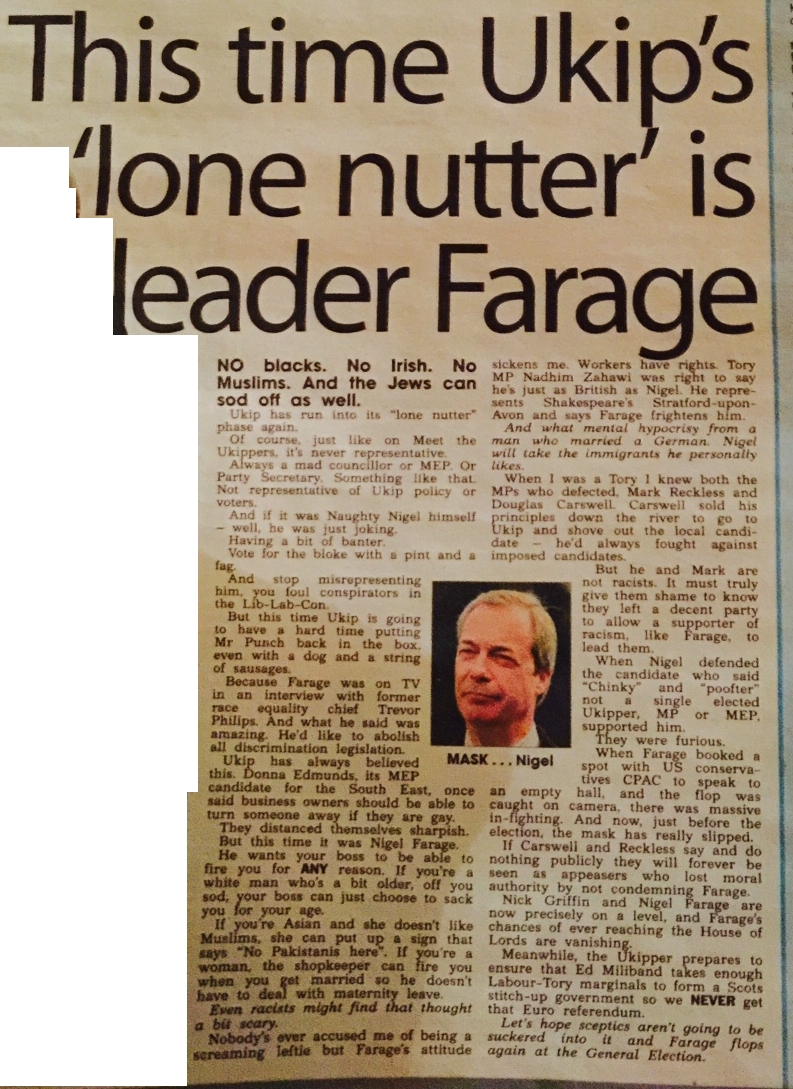
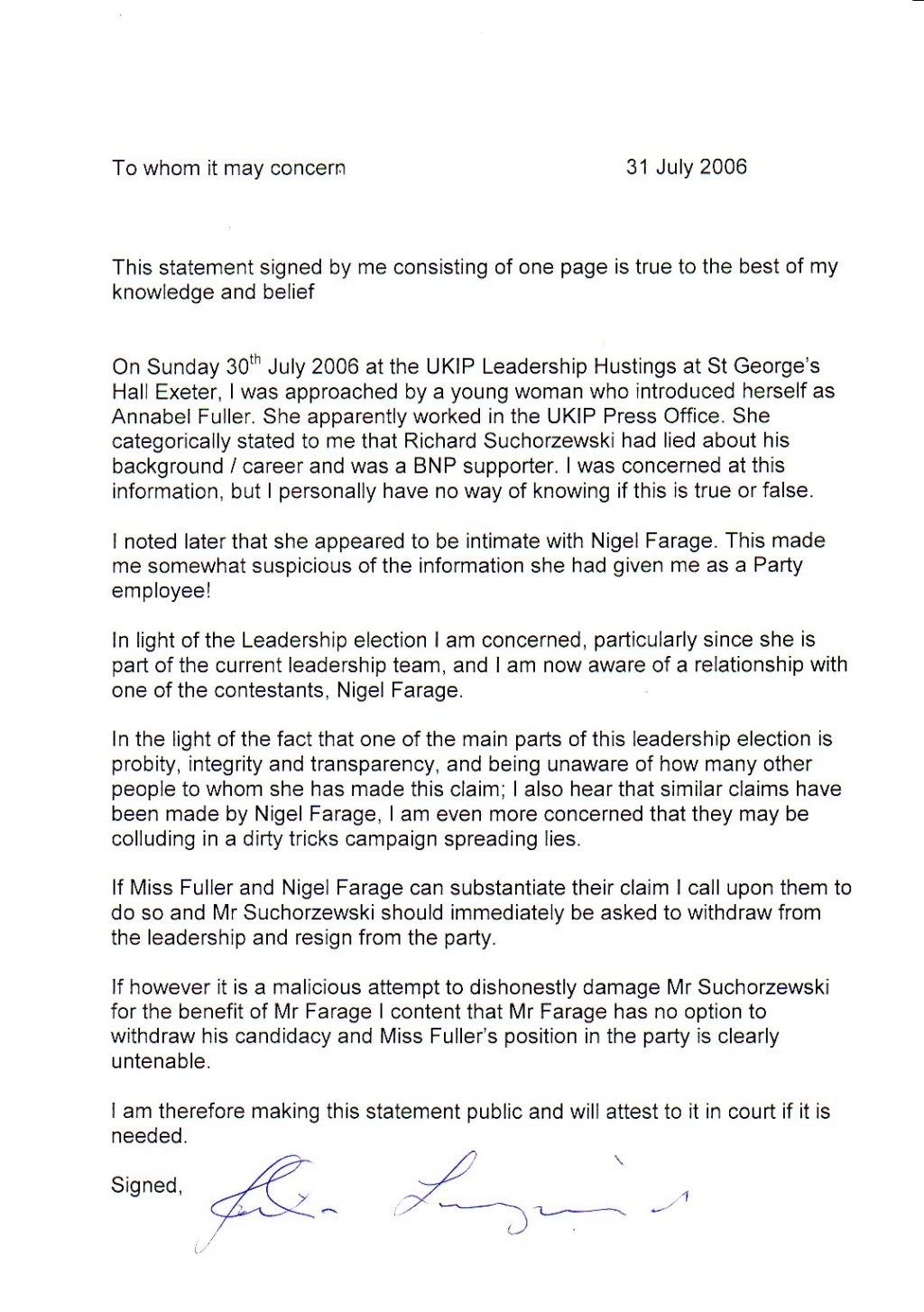
Ukip has manipulated the selection of prospective parliamentary candidates and is run by Nigel Farage as an “undemocratic” cabal, according to claims in a leaked cache of documents seen by The Times.
More than a dozen activists previously loyal to the Eurosceptic party have resigned over perceived efforts by Mr Farage and his allies to remove long-serving Ukip members from standing as MPs and MEPs in winnable seats.
As Mr Farage attempts to broaden Ukip’s appeal and to capitalise on its recent successes, some of his most longstanding foot-soldiers have accused the party of ignoring its own rules on selection procedures to the benefit of favoured candidates.
Neil Hamilton, now Ukip’s deputy chairman, warned in a private email that its list of MEP candidates for May’s European elections contained “manifest absurdities”.
“As you can imagine, I’m not pleased with the MEP selection process,” Mr Hamilton wrote. “Yet again, things have not been thought through properly and badly executed.”
In another leaked email, Will Gilpin, Ukip’s former chief executive, wrote: “When I saw the [MEP selection] list I concluded that the party doesn’t really want to change, that the same sycophancy will be the driving force.”
Mr Farage has gained support by pitching Ukip as an “anti-establishment” party seeking to shake up the old boys’ club in Westminster. Internal documents reveal, though, that senior figures questioned whether party leaders had tailored interview questions to discriminate against certain MEP candidates or had altered some candidates’ ratings to suit their own preferences.
Instead of allowing local branches to choose candidates for the European elections in May this year, Ukip required potential MEPs to undergo psychometric testing and a series of formal interviews and assessments. They were given a rating out of 100 based on their performance and placed on a shortlist that was voted on by every party member.
“There is the question of whether the final scores were ‘massaged’ by an internal clique to suit pre-determined outcomes,” Andrew Moncrieff, who remains on Ukip’s governing committee, wrote last year. “What started out as an attempt to produce a transparent, equitable system has turned into another classic Ukip ‘behind closed doors’ selection.”
Last night, a party spokesman said: “What we see are a series of claims by disappointed candidates. The system was fair and rigorous, and the quality of candidates continues to improve. As Ukip grows there are those who have been around a long time who feel that by dint of long service they are entitled to jobs and roles. The opposite is true, as today there is far greater competition. This can only be a good thing for the party and the country as a whole.”
Steve Crowther, the party chairman, had to reassure the party’s national executive committee last year that Mr Farage had “never at any stage given me even the slightest indication of who should and should not be on the list. Not once.”
Mr Moncrieff, who like Mr Hamilton did not make the European shortlist, questioned the involvement of “Nigel’s henchmen” in the process and asked why “paid party lackeys have done surprisingly well”. He suggested that a likely reason was “that it suits the party hierarchy to get people paid by the party elected as MEPs so they can be paid for by the EU”.
Two Ukip insiders have suggested that at least one candidate’s scores may have been downgraded.
“The candidate got his results [from the firm which carried out tests o/n behalf of Ukip],” one source said. “They told him he was one of the highest. His scores were higher than his position on the list, that was for sure.”
The insider said that members of the party’s governing committee were not shown the candidates’ scores and were simply presented with a ranked list of 60 candidates at the same time as it was published to members.
David Gale, Ukip’s former candidate for the police and crime commissioner role in Derbyshire, resigned last year after suggesting that one party official had justified the omission of an MEP candidate on the basis that “all the members would vote for him and we can’t have that”. Ukip strongly denied the claims at the time.
Rifts in the party over selection look set to continue into next year. Douglas Denny, a former Farage loyalist who joined Ukip in 1999, accused the party of being “immoral, undemocratic and deeply corrupt” after he was deselected as the party’s parliamentary candidate for Portsmouth South.
Mr Denny was selected 18 months ago after winning an open hustings but was dropped by Ukip’s leadership after it asserted the right to change candidates in so-called “key seats”. In a resignation note he said that Ukip had “demonstrated conclusively that they are willing to manipulate the MP candidates’ selection process . . . and have changed the rules recently to allow this to be done. Those choosing will be under the shadow of Nigel Farage.”
Andrew MacDowell, Portsmouth’s chairman, also resigned from the party in protest. Roger Bird, a Ukip member, told a local newspaper that Mr Denny’s deselection was a “routine event”.
More recently, the entire local party branch in South Hereford voted to dissolve itself in support of the prospective parliamentary candidate, Kip Waistell, who resigned after a Ukip MEP allegedly threatened to have him “deselected”.
Mr Waistell claimed in his resignation letter that “there are those within Ukip who have sought from day one to manipulate people against each other in this constituency”. Ukip’s response was that a “lacklustre” Mr Waistell “jumped before he was pushed”.
Last year, about 200 Ukip members paid £500 each to enter the process to become an MEP candidate in the European elections. Some 77 shortlisted names paid a further £360 for screening tests, bringing the party more than £125,000 in income.
Mr Crowther told NEC members in an email that the selection process was “calculated to be self-liquidating”. However, Ukip’s 2013 accounts listed the costs of MEP selection as £32,671, suggesting it made a profit of more than £95,000.
Caroline Gent, a Ukip councillor, wrote to the party’s NEC last year to express her “total dismay” after candidates she considered to be superior were passed over. “The whole thing stinks,” she said. “I thought UKIP were supposed to be honest.”





 Greg Lance - Watkins (Greg_L-W)




 . Re-TWEET my Twitterings












 Ukip-vs-EUkip