




 Greg Lance - Watkins (Greg_L-W)




&
&
Posted by:
Greg Lance – Watkins
Greg_L-W
eMail:
Greg_L-W@BTconnect.com
The BLOG:
https://InfoWebSiteUK.wordpress.com
The Main Web Site:
www.InfoWebSite.UK
~~~~~~~~~~#########~~~~~~~~~~
is what gives the remaining 10% a bad name!
 ~~~~~~~~~~#########~~~~~~~~~~
About
| George Cottrell |
|
|---|---|

Farage with Cottrell in June 2016
|
|
| Born | George Swinfen Cottrell October 1993 London, England |
| Criminal Charges | Conspiracy to commit money laundering, money laundering, wire fraud, mail fraud, blackmail and extortion. |
| Criminal Status | Released (March 2017) |
| Net worth | US $310 million |
| Occupation | Political aide and banker |
| Education | Malvern College |
| Nationality | British |
| Children | 0 |
| Parents |
Mark Cottrell The Hon. Fiona Cottrell |
| Relatives | Lord HeskethLord Manton |
Source: CLICK HERE
CAVEAT – PLEASE NOTE:
The articles below are copied from the web site
https://georgecottrell.wordpress.com/
This is NOT my web site and I have no control over its content, nor am I wittingly in contact with its owner or controler(s), therefore I can not vouch for its absolute accuracy however many of the facts I know to be correct and none have I noted to be, to my knowledge inaccurate, therefore I present it in good faith and in the belief that it presents accurate facts.
Make of it what you will. I was interested to note the details of criminality & links with Russia and money laundering which I was aware of and note that it confirms the details which I was aware of!
George Cottrell
Criminal Dossier
PARTNERS IN CRIME
On Friday, August 18th 2017 Cottrell and Farage were photographed together outside a London pub.
In addition to the security detail they were joined by Farage’s French mistress Laure Ferrari currently investigation by the European Anti-Fraud Office.
Cottrell departed with Farage and Ferrari in chauffeur driven Range Rover.


Part 1: Infiltration
On October 1st 2014 Arron Banks, an obscure insurance executive, announced a £1 million donation to Nigel Farage’s United Kingdom Independence Party an alliance that would go on to disrupt global politics.
Banks pictured with Farage announcing a £1 million donation
In the subsequent three years Banks’ has increased his fortune by hundreds of millions, accumulated an offshore insurance empire, obtained diplomatic status, bankrolled Brexit, befriended Trump and become a diamond mine proprietor – many times over.
While growing his consumer motor insurance company Southern Rock in 2013 Banks was introduced by his Bermudan lawyer to Apex Fund Services in Grand Cayman to discuss some reinsurance opportunities. Coincidentally Apex were the custodians of a secretive multi billion dollar money fund administered by a cluster of Nevis foundations.
This highly suspect arrangement was being represented by an army of securities lawyers and accountants however one connected entity was being fronted by a then 19-year-old George Swinfen Cottrell: T1 Group. Cottrell has never disclosed his exact role beyond describing himself as a “junior advisor” because T1 Group was never regulated, licensed or authorized to transact securities.
Banks and Cottrell both own houses in Gloucestershire and Mustique
Never more than six feet away from Banks is his permatan right hand man Andrew Wigmore, a well connected Belizian diplomat and fixer. Wigmore is a serial strawman – a nominee shareholder and registered representative for hundreds of entities. Protected from prosecution by his diplomatic immunity he illegally shelters offshore wealth from tax authorities and shields assets from creditors. Wigmore was formerly an associate of Boris Berezovsky, an exiled Russian billionaire, who was a business partner of Cottrell’s mentor Scot Young.
Connections to Russia are well established
It is unknown whether Banks or Wigmore ever met or engaged in business with Cottrell prior to October 2014 when Cottrell, who had recently been terminated by Banca Privada d’Andorra, was employed by Precision Risk and Intelligence – a company owned and controlled by Banks.
Sources within the United Kingdom Independence Party have confirmed that Cottrell’s noticeable involvement began during the 2015 general election when he was dispatched to a target constituency to coordinate the local campaign. The candidate, a prominent businessman, Jamie Huntman was a key ally of Banks and was referenced repeatedly in The Bad Boys of Brexit.
Huntman was unsuccessful in his bid for office but not for want of money, invoices seen by this blog indicate that statutory spending limits were grossly exceeded – a criminal offense. Larger invoices were routinely countersigned by Cottrell in addition to the local agent. Cottrell, as many suspected then, was no more than Banks’ representative, spending the millions his boss had donated.
How it started
It was just before midday on November 11th 2010 when Paul Castle threw himself under a tube train in what was an apparent suicide. Earlier that morning his life had been threatened by Russian mobsters, representing one of his many dangerous creditors.
Paul Castle, a multi-millionaire property mogul and polo playing friend of Prince Charles was doing a favor for an old friend when he agreed to give the young, recently expelled, George Cottrell some work experience. Castle was an acquaintance of Cottrell’s aristocratic, former Penthouse Pet mother Fiona who had once dated Prince Charles.
A little after a month following Cottrell’s unceremonious dismissal from his exclusive boarding school — due to his illegal gambling proclivities having been uncovered — he was walking to Castle’s Brook Street office for what was meant to be a short informal interview prior to his first day. Upon Cottrell’s arrival, it was apparent that Castle was otherwise engaged, a shouting match had broken out on the staircase which was being blocked by heavies. Castle was in a tense negotiation with a notorious Singaporean hard money lender.
Scot Young was quick to respond to Castle’s pleas for help, interrupting his lunch and rushing over from nearby Mount Street, Young was able to placate this creditor by promising full settlement the next day — in cash. Embarrassed by what Cottrell had witnessed and sensitive to the fact that Cottrell’s father was also a creditor Castle proposed that the interview be conducted over lunch. That afternoon Cottrell, Castle and Young decamped to Scott’s restaurant and spent the rest of the day drinking champagne to forget.
Nothing would ever be the same; 48-hours later Castle would be dead, and Young fearing for his life would go in to hiding.
The exact events leading up to Cottrell’s subsequent business dealings with Young two years later are shrouded in secrecy and have been deliberately obfuscated.
Cottrell never qualified high school and was therefore ineligible to attend university, he gained an internship at a small specialist corporate finance house a year hence but this does not explain the protracted gap. Interestingly Cottrell was appointed a director, for one day, of an entity called Upsilon Investments which was registered to one of his offshore trust properties in Kensington. He was listed as a co-director with an individual named Vivian Combs a name that has appeared as a nominee director for a Young linked shell entity. The precise activities of Upsilon are not immediately clear, no financials were ever filed and its nature of business was classified as “financial intermediation not elsewhere classified.”
Young’s history of money laundering, tax evasion and other criminal activity is suitably documented. An infamous fixer for the super-rich, he had extensive Russian contacts and links to organized crime. He was jailed in January 2013 for contempt of court relating to his efforts to conceal a supposed multi-billion-pound fortune.
Starting in late 2012 Cottrell based himself out of an office located at 44 Hertford Street, the same building which accommodated Young’s office. The peculiar arrangement was located on two upper floors, meanwhile the ground floor setup involved an airport-style metal detector for a short while allegedly to “screen contractors.” Much of the floor space was consumed by filing cabinets and company registrar folders occupied every inch of shelfing. The main boardroom, located at the front of the building, was converted in to Cottrell and Young’s joint office shared only with lingering stale cigarette smoke.
During Youngs incarceration it has been difficult to identify anyone who would have been tasked with managing his complex affairs, recent deaths in his inner circle were not just limited to Castle. This blog has been made aware of a supposed mutual legal assistance treaty seeking information relating to Cottrell’s involvement around this time with Young.
Cottrell and Young were regular fixtures at Scott’s restaurant, which they nonchalantly referred to as the “cafeteria” given its proximity to their office, and at Boujis nightclub in South Kensington near Cottrell’s residence. Given the degree of scrutiny Young was subject to his inexperienced protégé would have made an excellent conduit to repatriate his offshore wealth.
It wasn’t to last; by April 2014 Cottrell had finally been identified by the U.S. Department of Treasury while on December 8th Young would plummet four stories on to iron railings in an alleged suicide.
Analysis: The “Tell-All” Exclusive
Shortly after the initial publication of this blog Cottrell granted an exclusive tell-all interview to The Daily Telegraph.
Although nearly 3,000 words in length the article fails to identify or explain the extent of Cottrell’s criminality.
Scroll down for the full analysis:
George Cottrell was a minor aristocrat, a UKIP fundraiser and member of Nigel Farage’s inner circle, a self-made millionaire and a compulsive gambler, all by the age of 23. And then US federal agents caught up with him… He tells William Cash about his spectacular fall from grace
Seated in a dark suit with a glass of claret in front of him at lunch recently in the Sydney Arms in Chelsea, George Cottrell describes the evening of 23 June 2016 as ‘the best night of my life – something I’ll never forget’.
On that day of the EU referendum poll, indeed throughout that overheated political summer, Cottrell had been in the ‘jump seat’ at Nigel Farage’s side, working as his aide-de-camp, gatekeeper and campaign fixer – from booking his helicopters to letting Simpson’s Tavern in the City know that Nigel was on the way for what he likes to call a ‘PFL’ (Proper F—ing Lunch).
At the age of just 23, Cottrell is accustomed to the high life: he’s the nephew of Lord Hesketh, the aristocratic former Tory minister and F1 racing-team owner, and his mother Fiona – once a Penthouse Pet of the Month – was romantically linked to Prince Charles in the late 1970s.
On referendum day, Cottrell decided that the best way for Farage’s inner entourage – including donor Arron Banks – to calm their nerves was a PFL at Zafferano, an Italian restaurant in Belgravia. Once the third bottle of chianti was opened, the mood improved. ‘We spent most of the time talking about what would happen if we lost, and Arron told me I was a pessimist and that we would win. But Nigel was pretty brooding throughout.’
However, when Sunderland voted for leave by a bigger than expected margin, Cottrell sensed a betting opportunity. ‘At 10pm, I couldn’t believe I was still getting 9/1 [for a majority leave vote],’ he says. ‘We were in our campaign office and I was tracking all the major stock indices, the dollar and pound currency markets. When it got to 3am, I was getting my managers out of bed to get me another 50 grand on here, another 50 grand there, to short sterling. I just couldn’t help myself.’
Tim Shipman claims in his book All Out War that Nigel Farage conceded the referendum at 10 pm to enable his inner circle to profit.
Cottrell won a six-figure sum that night but promptly ‘lost most of it the next day, on some horse running called Exit Europe or something like that. I was a compulsive, habitual, addicted gambler.’ Generous but self-effacing, with a sharp memory, Cottrell relates the events of that day and night with the self-assurance that the English public-school system produces – a chauffeur brought him to lunch, and only later did I realise he had bodyguards in attendance.
Cottrell continually boasted about his gambling escapades and his “whale” status at various casinos. Cottrell’s prolific gambling also enabled him to mask his personal tax affairs by repatriating his illegally obtained, untaxed offshore wealth in the form of casino chips which would be redeemed for cash. Cottrell had a covert security detail in 2011/12 that was exclusively Russian.
Just three weeks after the referendum vote, this appetite for high stakes nearly ended up with Cottrell gambling away two decades of his life to a maximum security US jail. Having attended the Republican convention in Cleveland in July, he was confronted by eight armed federal Inland Revenue Service (IRS) agents as he got off a plane in Chicago, with Nigel Farage just behind him. He was handcuffed and detained in a local federal jail. Back in Britain, ‘Posh George’ – as he is known within Farage’s inner circle – became big news: the Daily Mirror headline was ‘Farage aide faces 20 years for blackmail drug plot’.
Until now, Cottrell has given no interviews about what happened when he stepped off that plane in Chicago and disappeared for eight months into the bowels of the US justice system, holed up with gang leaders and murderers.
Cottrell conducted his interview with The Telegraph shortly after the initial publication of this blog. He was interviewed by William Cash a former UKIP candidate and son of British MP Sir Bill Cash. The Telegraph is owned by the billionaire Barclay brothers who incidentally are significant UKIP donors.
‘Prison life was fascinating and had I not have been to boarding school it would have been infinitely harder,’ says Cottrell. ‘I was housed in maximum-security facilities in Chicago and Arizona. I was placed with murderers, rapists, paedophiles, assassins, Isil terrorists, cartel kingpins and even a Mafia boss. I had to fight for my life on an almost daily basis. I still have fractured ribs today.’ Due to his case’s media profile, for the majority of his nine-month incarceration he was provided with his own cell.
Cottrell’s special treatment was no doubt facilitated by his political connections and $2,000 per hour attorney.
It was a bewildering fall for a the scion of a landed Yorkshire family. He was educated in Mustique followed by Malvern College, which he left aged 16 after being reprimanded for a gambling habit so bad that he was reading the Racing Post at 12 and betting illegally in bookies. Unsurprisingly, Cottrell says, he fell out with his family over the episode.
Cottrell was disinherited from a £250 million family trust fund following his expulsion from his exclusive British boarding school, Malvern College.
The habit at least gave him a head for numbers and complicated financial trades, and he was offered a job raising capital for a corporate finance house. This led to him, aged just 19, helping to set up a multibillion-pound private office in Mayfair for a well-known ‘international’ family. ‘I was the youngest person there by a long way,’ he says. ‘They took me under their wing, and I was taught the ropes, so to speak.’
Cottrell interned at Maxim Corporate Finance following his expulsion from Malvern College. He was listed as a director for ARA Capital, an entity controlled by Russian billionaire and Putin ally Roman Abramovich.
He learned about the murky and complicated world of ‘shadow banking’, secret offshore accounts and sophisticated financial structures in such jurisdictions as Panama, Andorra and Switzerland. He did well, and was soon working as a London-based banker for an offshore private bank (which was under investigation by the US authorities as a ‘foreign financial institution of primary money-laundering concern’). It was these skills that landed Cottrell an unpaid role in 2016, running Nigel Farage’s private office at UKIP’s Mayfair headquarters and, in the run-up to the EU referendum, as a chief fundraiser for the party. The young Cottrell moved into Farage’s glass office and had ‘my Berry Bros wine collection stashed in the cabinet’.
Cottrell fraudulently concealed and disguised ultimate beneficial ownership information during the formation of these financial structures. Cottrell on at least one occasion submitting stolen passport information on a Form A declaration.
His contribution? To ‘successfully raise millions’ during campaigning, and he says, ‘It was very important for [donors] to have face time with Nigel, and that’s where I came in. My role with fundraising meant that I was also looking after Nigel.’
Cottrell illegally financed UKIP and Leave.EU by soliciting and accepting impermissible donations.
Cottrell’s often reckless temperament may help to explain the unusually close bond between him and Farage. Did he view Nigel as a father figure?
‘Yes,’ replied George. ‘In many things. I mean, I still do.’
Did Farage know how bad his gambling problem had become? ‘Yes. It was out of control. I’d saunter to the William Hill round the corner with a Harvey Nichols bag with 50 grand in it, to have a bet on the 2.05 at Lingfield on a horse I knew nothing about. I was neglecting work, friends, family, girlfriends. It was all-consuming.’
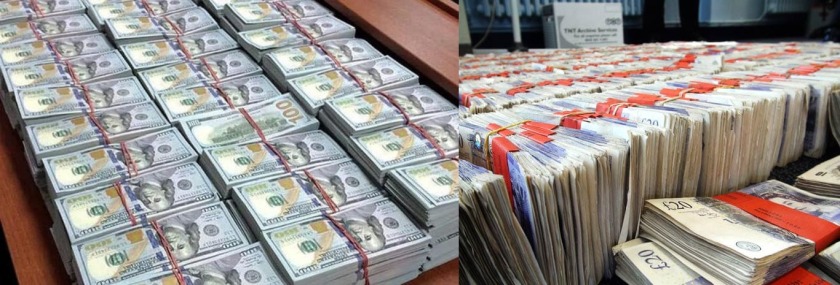
Cottrell would regularly carry around large amounts of cash often in sealed casino packets of £5,000.
How did it affect him when he lost?
‘It didn’t really. It happened so regularly’.
Despite the losses, Cottrell managed to maintain a millionaire lifestyle from the age of 18 to 21, with a concierge looking after him 24 hours a day. ‘I always managed to fund my gambling,’ he says. ‘Later on, I was earning millions and losing millions.’
Cottrell was illegally earning money by facilitating tax evasion and money laundering. Cottrell would charge a basic 10% plus a percentage of anticipated tax savings.
His role at the offshore bank was to bring in new custom and he quickly learnt how private bankers did business with clients. ‘No business cards. No emails. Meetings in person. Lots of travel. Most of our correspondence was done by mail.’ And rule number one: never meet clients in the continental United States. ‘We were not licensed to operate there and we were under scrutiny,’ adds Cottrell.
Cottrell would maintain little or no paper trail as he was fully aware of his criminal conduct. Cottrell failed to gain FCA, SEC and CYSEC authorization.
The offshore ‘leading-edge tax solutions’ that Cottrell was putting in place were to maximise tax efficiency. They were not illegal, he claims. ‘We’re talking about people who have just completed an IPO [initial public offering], they’re about to receive hundreds of millions of dollars, and they needed the tax structures put in place and the offshore banking mechanisms to provide pension provision and the like.’
The tax structures were essentially money laundering services exclusively marketed to tax dodgers, organized crime and individuals facing bankruptcy/divorce proceedings who wanted to conceal or disguise the nature, the location, the source, the ownership, or the control of the funds or assets.
While working for the bank, Cottrell was contacted by two Arizona businessmen who wanted to sell their multimillion-dollar property portfolio and were interested in the services Cottrell’s bank could offer. They wanted to meet at the earliest possible convenience in America. ‘I checked with my boss and with compliance: that’s a no-no. I first said I couldn’t meet with them but while my more experienced colleagues weren’t willing to take the risks in North America, I was. The meeting was proposed to be in Las Vegas. And I can’t resist gambling.’
Cottrell was contracted by offshore banks as a “financial intermediary” as such internal compliance would not have screened his prospective leads unless they contacted the bank first. Cottrell was obtaining leads from a dark web user identified in court documents as “Banker”.
Cottrell flew to Vegas and met the two businessmen in their hotel suite. Dinner followed at ‘a great Michelin-star restaurant, and I get handed the wine list. I was 20 years old and hadn’t been ID’d. When the pudding arrived, one of the businessmen leaned in to the round marble table and said, “George, we’ve got something to tell you. We make about two and a half million a year trafficking cocaine from Phoenix to New York, in net profits.” So I say, “What about the property?” “Oh, we do have some.” I say, “Well, this is very interesting, what kind of margins are there on that?” Yeah, drunk me, asking a question.’
Cottrell is a alcoholic who has a habbit of ordering the most expensive wine to impress people.
The meeting continued for another 10 minutes then Cottrell took the next flight back to London. ‘It was a very scary situation when you’re sitting in front of two people who have just represented that they’re trafficking millions of dollars’ worth of drugs on a regular basis,’ he recalls. ‘I knew that I had a duty to report their serious criminality. But a colleague said, “If you do report it, we’re going to be under the microscope. If they contact you again, then you report it.”’
Cottrell was already involved in extensive criminality which could have been discovered by making a report to law enforcement.
Cottrell heard nothing. ‘I just put it down to a bad experience,’ he says.
That was back in 2014. It wasn’t until July 2016 that Cottrell stepped off that plane in Chicago and was placed under arrest. He had no idea why he was being charged. From jail, he was allowed to call the British embassy in Washington DC, who told him that the US State Department had just informed them that he had been arrested for ‘financial irregularities’. It was now 3am on Saturday morning and he was allowed one more call, to his parents in London, which ended swiftly when the phone went dead. He had no lawyer, no phone and still no idea what these ‘irregularities’ were.
Cottrell’s email and bank accounts were immediately seized upon his arrest according to reports at the time however financial court filings are still under seal.
On the eighth floor of a skyscraper federal prison in downtown Chicago, Cottrell was strip-searched, put into an orange jumpsuit and told to sleep on a metal bench, ahead of his court appearance the following day.
The next morning, he was transported to court in a police convoy. ‘I felt like I was a terrorist,’ he says. ‘I’m brought up in shackles and handcuffs, chained round my waist. And I walk into this courtroom, and a dishevelled lawyer hands me his card, and says, “Mr Cottrell, until you can arrange your own counsel, I’m a public defender. I’m going to be representing you.”’ The lawyer handed Cottrell an eight-page document in which George read that he was being charged on 21 counts including ‘conspiracy to commit money-laundering, money-laundering, wire fraud, mail fraud, blackmail and extortion. Penalties: 20 years, basically, each charge,’ he says.
Cottrell’s statutory maximum penalty was 20 years.
Cottrell was later accused of using various banks under investigation to launder dirty money for drug cartels and other criminals, and also offering his offshore expertise on the dark web. George was to learn that the two businessmen he had met in Las Vegas were in fact IRS federal agents who were ‘all wired. The whole restaurant was staffed by the Department of the Treasury and the IRS Criminal Investigations Division, and it was all one big set-up.’
Cottrell had been under investigation by FinCEN for years. Cottrell routinely used the dark web and specialist software to communicate with the offshore banks and clients. Cottrell would provide a USB device to clients to access internet banking anonymously.
His bond hearing was set for the following Tuesday.
He was sent back to a maximum-security federal jail in Chicago where 80 per cent of the population was black, and most of the rest Hispanic or Asian. ‘I was the only white person there. And I’d been wearing a suit all my life,’ Cottrell recalls. ‘If I learnt anything from watching prison shows, it was don’t show any signs of weakness or you’ll be preyed upon.
Cottrell constantly espouses racist views and slurs, as he aligned himself with UKIP he would of associated himself with a white supremacist discriminatory prison gang.
‘My second cellmate was a notorious murderer and gangster in Chicago called Paris Poe. He was responsible for the murder of several people, including an FBI informant in front of his wife, six-year-old and four-year-old.’
Fortunately for Cottrell, he was ‘invisible to these gangsters because I had no gang affiliation’. He also needed to convince his fellow inmates that he was not a sex offender. ‘When I said I was charged with money-laundering, that was fine.’
Cottrell was denied bail. Over the months, he couldn’t resist the opportunity to gamble and ran up a poker debt with the boss of an Eastern European gang called Mafia Mitsu (Cottrell’s lawyers were able to send funds to clear the debt). Then, with help from his lawyers (funded by his family), he was moved to a maximum-security prison in Arizona. There, he and his lawyers finally received the court documents with all the evidence and charges.
Cottrell’s bank accounts are subject to civil forfeiture.
In the event, the evidence against Cottrell apparently didn’t add up. Of the 21 counts against him, 20 were dismissed after he pleaded guilty to one count of wire fraud and was released at sentencing in March. While the IRS thought Cottrell was the banking linchpin of a drug cartel, it would appear that actually he was a young man making drunken claims in a Vegas restaurant. After eight months of incarceration, he was free.
Cottrell cooperated with the investigating federal agents and may be called to testify in future criminal or civil proceedings. Court documents relating to his cooperation are sealed, if Cottrell provided genuine information about his clients banking arrangements he could be entitled to a multi-million-dollar reward.
Looking back on his ordeal, how does he think Farage, his UKIP colleagues and his family regard his behaviour? There was, he says, ‘Utter shock and disbelief given how involved I was. Everybody stuck by me and supported me.’ He admits he was wrong not to report what ‘I knew to be serious criminal activity’; moreover, he was not licensed by the US Securities and Exchange Commission to offer financial advice in the US, and admits to ‘enabling and promoting aggressive tax avoidance programmes. I built my reputation on integrity and absolute discretion. This episode has tarnished many people, not just myself.’
Cottrell has now been uncovered, he personally enabled the evasion of millions of dollars of tax revenue, laundered large fortunes for criminals and funnelled illegal donations to political campaigns. He has been discredited along with all his associates.
Cottrell admits he was foolish but claims that he has learnt much. ‘My youth and inexperience were ruthlessly exploited,’ he says. ‘It was truly humbling, and has undoubtedly made me stronger. [In prison] I read a huge amount of history and political books and I assisted other inmates with legal and tax advice by hosting an informal legal surgery.’
Cottrell was fully aware of his actions, his criminal career stretched over 5 years. Although Cottrell never graduated high school he operated at C-Suite level, he is no victim just a career fraudster.
He adds, ‘I interacted with a segment of society I ordinarily would have been oblivious to. Being incarcerated made me realise how privileged I have been all my life and, while I am grateful I never had a drug addiction, I finally realised that I had a gambling addiction that was almost as damaging.’ Cottrell says he eventually kicked the gambling habit in prison. What is he doing now for a living? Charitable work, he tells me.
Cottrell has stopped gambling because his bank accounts and assets have been seized pending forfeiture proceedings.
A year after the referendum poll, Cottrell attended a lavish anniversary party held at a mansion owned by Arron Banks outside Bristol. ‘The party was fantastic and despite my unfortunate adventure, and everything I went through, I still maintain 2016 was the best year of my life,’ he says. ‘Brexit and Trump. Nothing better.’
Cottrell has been welcomed back to the inner-circle so that Farage and Banks can make sure he didn’t disclose information about the illegal donations and kickbacks he funnelled to UKIP and Leave.EU respectively.
Telegraph Magazine Interview:
‘Had I not been to boarding school, prison would have been infinitely harder’
George Cottrell was a minor aristocrat, a UKIP fundraiser and member of Nigel Farage’s inner circle, a self-made millionaire and a compulsive gambler, all by the age of 23. And then US federal agents caught up with him… He tells William Cash about his spectacular fall from grace
Seated in a dark suit with a glass of claret in front of him at lunch recently in the Sydney Arms in Chelsea, George Cottrell describes the evening of 23 June 2016 as ‘the best night of my life – something I’ll never forget’.
On that day of the EU referendum poll, indeed throughout that overheated political summer, Cottrell had been in the ‘jump seat’ at Nigel Farage’s side, working as his aide-de-camp, gatekeeper and campaign fixer – from booking his helicopters to letting Simpson’s Tavern in the City know that Nigel was on the way for what he likes to call a ‘PFL’ (Proper F—ing Lunch).
At the age of just 23, Cottrell is accustomed to the high life: he’s the nephew of Lord Hesketh, the aristocratic former Tory minister and F1 racing-team owner, and his mother Fiona – once a Penthouse Pet of the Month – was romantically linked to Prince Charles in the late 1970s.
On referendum day, Cottrell decided that the best way for Farage’s inner entourage – including donor Arron Banks – to calm their nerves was a PFL at Zafferano, an Italian restaurant in Belgravia. Once the third bottle of chianti was opened, the mood improved. ‘We spent most of the time talking about what would happen if we lost, and Arron told me I was a pessimist and that we would win. But Nigel was pretty brooding throughout.’
However, when Sunderland voted for leave by a bigger than expected margin, Cottrell sensed a betting opportunity. ‘At 10pm, I couldn’t believe I was still getting 9/1 [for a majority leave vote],’ he says. ‘We were in our campaign office and I was tracking all the major stock indices, the dollar and pound currency markets. When it got to 3am, I was getting my managers out of bed to get me another 50 grand on here, another 50 grand there, to short sterling. I just couldn’t help myself.’
Cottrell won a six-figure sum that night but promptly ‘lost most of it the next day, on some horse running called Exit Europe or something like that. I was a compulsive, habitual, addicted gambler.’ Generous but self-effacing, with a sharp memory, Cottrell relates the events of that day and night with the self-assurance that the English public-school system produces – a chauffeur brought him to lunch, and only later did I realise he had bodyguards in attendance.
Just three weeks after the referendum vote, this appetite for high stakes nearly ended up with Cottrell gambling away two decades of his life to a maximum security US jail. Having attended the Republican convention in Cleveland in July, he was confronted by eight armed federal Inland Revenue Service (IRS) agents as he got off a plane in Chicago, with Nigel Farage just behind him. He was handcuffed and detained in a local federal jail. Back in Britain, ‘Posh George’ – as he is known within Farage’s inner circle – became big news: the Daily Mirror headline was ‘Farage aide faces 20 years for blackmail drug plot’.
Until now, Cottrell has given no interviews about what happened when he stepped off that plane in Chicago and disappeared for eight months into the bowels of the US justice system, holed up with gang leaders and murderers.
‘Prison life was fascinating and had I not have been to boarding school it would have been infinitely harder,’ says Cottrell. ‘I was housed in maximum-security facilities in Chicago and Arizona. I was placed with murderers, rapists, paedophiles, assassins, Isil terrorists, cartel kingpins and even a Mafia boss. I had to fight for my life on an almost daily basis. I still have fractured ribs today.’ Due to his case’s media profile, for the majority of his nine-month incarceration he was provided with his own cell.
George Cottrell
It was a bewildering fall for a the scion of a landed Yorkshire family. He was educated in Mustique followed by Malvern College, which he left aged 16 after being reprimanded for a gambling habit so bad that he was reading the Racing Post at 12 and betting illegally in bookies. Unsurprisingly, Cottrell says, he fell out with his family over the episode.
The habit at least gave him a head for numbers and complicated financial trades, and he was offered a job raising capital for a corporate finance house. This led to him, aged just 19, helping to set up a multibillion-pound private office in Mayfair for a well-known ‘international’ family. ‘I was the youngest person there by a long way,’ he says. ‘They took me under their wing, and I was taught the ropes, so to speak.’
He learned about the murky and complicated world of ‘shadow banking’, secret offshore accounts and sophisticated financial structures in such jurisdictions as Panama, Andorra and Switzerland. He did well, and was soon working as a London-based banker for an offshore private bank (which was under investigation by the US authorities as a ‘foreign financial institution of primary money-laundering concern’). It was these skills that landed Cottrell an unpaid role in 2016, running Nigel Farage’s private office at UKIP’s Mayfair headquarters and, in the run-up to the EU referendum, as a chief fundraiser for the party. The young Cottrell moved into Farage’s glass office and had ‘my Berry Bros wine collection stashed in the cabinet’.
His contribution? To ‘successfully raise millions’ during campaigning, and he says, ‘It was very important for [donors] to have face time with Nigel, and that’s where I came in. My role with fundraising meant that I was also looking after Nigel.’
Cottrell’s often reckless temperament may help to explain the unusually close bond between him and Farage. Did he view Nigel as a father figure?
‘Yes,’ replied George. ‘In many things. I mean, I still do.’
Did Farage know how bad his gambling problem had become? ‘Yes. It was out of control. I’d saunter to the William Hill round the corner with a Harvey Nichols bag with 50 grand in it, to have a bet on the 2.05 at Lingfield on a horse I knew nothing about. I was neglecting work, friends, family, girlfriends. It was all-consuming.’
How did it affect him when he lost?
‘It didn’t really. It happened so regularly’.
Despite the losses, Cottrell managed to maintain a millionaire lifestyle from the age of 18 to 21, with a concierge looking after him 24 hours a day. ‘I always managed to fund my gambling,’ he says. ‘Later on, I was earning millions and losing millions.’
His role at the offshore bank was to bring in new custom and he quickly learnt how private bankers did business with clients. ‘No business cards. No emails. Meetings in person. Lots of travel. Most of our correspondence was done by mail.’ And rule number one: never meet clients in the continental United States. ‘We were not licensed to operate there and we were under scrutiny,’ adds Cottrell.
The offshore ‘leading-edge tax solutions’ that Cottrell was putting in place were to maximise tax efficiency. They were not illegal, he claims. ‘We’re talking about people who have just completed an IPO [initial public offering], they’re about to receive hundreds of millions of dollars, and they needed the tax structures put in place and the offshore banking mechanisms to provide pension provision and the like.’
While working for the bank, Cottrell was contacted by two Arizona businessmen who wanted to sell their multimillion-dollar property portfolio and were interested in the services Cottrell’s bank could offer. They wanted to meet at the earliest possible convenience in America. ‘I checked with my boss and with compliance: that’s a no-no. I first said I couldn’t meet with them but while my more experienced colleagues weren’t willing to take the risks in North America, I was. The meeting was proposed to be in Las Vegas. And I can’t resist gambling.’
Cottrell flew to Vegas and met the two businessmen in their hotel suite. Dinner followed at ‘a great Michelin-star restaurant, and I get handed the wine list. I was 20 years old and hadn’t been ID’d. When the pudding arrived, one of the businessmen leaned in to the round marble table and said, “George, we’ve got something to tell you. We make about two and a half million a year trafficking cocaine from Phoenix to New York, in net profits.” So I say, “What about the property?” “Oh, we do have some.” I say, “Well, this is very interesting, what kind of margins are there on that?” Yeah, drunk me, asking a question.’
The meeting continued for another 10 minutes then Cottrell took the next flight back to London. ‘It was a very scary situation when you’re sitting in front of two people who have just represented that they’re trafficking millions of dollars’ worth of drugs on a regular basis,’ he recalls. ‘I knew that I had a duty to report their serious criminality. But a colleague said, “If you do report it, we’re going to be under the microscope. If they contact you again, then you report it.”’
Cottrell heard nothing. ‘I just put it down to a bad experience,’ he says.
That was back in 2014. It wasn’t until July 2016 that Cottrell stepped off that plane in Chicago and was placed under arrest. He had no idea why he was being charged. From jail, he was allowed to call the British embassy in Washington DC, who told him that the US State Department had just informed them that he had been arrested for ‘financial irregularities’. It was now 3am on Saturday morning and he was allowed one more call, to his parents in London, which ended swiftly when the phone went dead. He had no lawyer, no phone and still no idea what these ‘irregularities’ were.
On the eighth floor of a skyscraper federal prison in downtown Chicago, Cottrell was strip-searched, put into an orange jumpsuit and told to sleep on a metal bench, ahead of his court appearance the following day.
The next morning, he was transported to court in a police convoy. ‘I felt like I was a terrorist,’ he says. ‘I’m brought up in shackles and handcuffs, chained round my waist. And I walk into this courtroom, and a dishevelled lawyer hands me his card, and says, “Mr Cottrell, until you can arrange your own counsel, I’m a public defender. I’m going to be representing you.”’ The lawyer handed Cottrell an eight-page document in which George read that he was being charged on 21 counts including ‘conspiracy to commit money-laundering, money-laundering, wire fraud, mail fraud, blackmail and extortion. Penalties: 20 years, basically, each charge,’ he says.
Cottrell was later accused of using various banks under investigation to launder dirty money for drug cartels and other criminals, and also offering his offshore expertise on the dark web. George was to learn that the two businessmen he had met in Las Vegas were in fact IRS federal agents who were ‘all wired. The whole restaurant was staffed by the Department of the Treasury and the IRS Criminal Investigations Division, and it was all one big set-up.’
His bond hearing was set for the following Tuesday.
He was sent back to a maximum-security federal jail in Chicago where 80 per cent of the population was black, and most of the rest Hispanic or Asian. ‘I was the only white person there. And I’d been wearing a suit all my life,’ Cottrell recalls. ‘If I learnt anything from watching prison shows, it was don’t show any signs of weakness or you’ll be preyed upon.
‘My second cellmate was a notorious murderer and gangster in Chicago called Paris Poe. He was responsible for the murder of several people, including an FBI informant in front of his wife, six-year-old and four-year-old.’
Fortunately for Cottrell, he was ‘invisible to these gangsters because I had no gang affiliation’. He also needed to convince his fellow inmates that he was not a sex offender. ‘When I said I was charged with money-laundering, that was fine.’
Cottrell was denied bail. Over the months, he couldn’t resist the opportunity to gamble and ran up a poker debt with the boss of an Eastern European gang called Mafia Mitsu (Cottrell’s lawyers were able to send funds to clear the debt). Then, with help from his lawyers (funded by his family), he was moved to a maximum-security prison in Arizona. There, he and his lawyers finally received the court documents with all the evidence and charges.
In the event, the evidence against Cottrell apparently didn’t add up. Of the 21 counts against him, 20 were dismissed after he pleaded guilty to one count of wire fraud and was released at sentencing in March. While the IRS thought Cottrell was the banking linchpin of a drug cartel, it would appear that actually he was a young man making drunken claims in a Vegas restaurant. After eight months of incarceration, he was free.
Looking back on his ordeal, how does he think Farage, his UKIP colleagues and his family regard his behaviour? There was, he says, ‘Utter shock and disbelief given how involved I was. Everybody stuck by me and supported me.’ He admits he was wrong not to report what ‘I knew to be serious criminal activity’; moreover, he was not licensed by the US Securities and Exchange Commission to offer financial advice in the US, and admits to ‘enabling and promoting aggressive tax avoidance programmes. I built my reputation on integrity and absolute discretion. This episode has tarnished many people, not just myself.’
Cottrell admits he was foolish but claims that he has learnt much. ‘My youth and inexperience were ruthlessly exploited,’ he says. ‘It was truly humbling, and has undoubtedly made me stronger. [In prison] I read a huge amount of history and political books and I assisted other inmates with legal and tax advice by hosting an informal legal surgery.’
He adds, ‘I interacted with a segment of society I ordinarily would have been oblivious to. Being incarcerated made me realise how privileged I have been all my life and, while I am grateful I never had a drug addiction, I finally realised that I had a gambling addiction that was almost as damaging.’ Cottrell says he eventually kicked the gambling habit in prison. What is he doing now for a living? Charitable work, he tells me.
A year after the referendum poll, Cottrell attended a lavish anniversary party held at a mansion owned by Arron Banks outside Bristol. ‘The party was fantastic and despite my unfortunate adventure, and everything I went through, I still maintain 2016 was the best year of my life,’ he says. ‘Brexit and Trump. Nothing better.’
Première
This blog is dedicated to exposing convicted criminal George Cottrell. Over the next weeks and months we will be publishing evidence detailing his extensive criminal activities.
Cottrell funneled impermissible donations to various Leave organizations during the United Kingdom’s EU Referendum in 2016.
Cottrell, on at least two occasions, arranged for a UKIP donation originating from Russia to be fronted by a permissible donor.
Cottrell, using cash, repeatedly incurred sizeable EU Referendum campaign expenditure personally to circumvent reporting requirements.
Cottrell cooperated with the U.S. Internal Revenue Service in 2016 to receive a reduced sentence and collect a potential multi-million dollar “informant award” relating to federal income tax evasion that Cottrell facilitated.
Cottrell personally laundered hundreds of millions of dollars of dirty money on behalf of a transnational organized crime group.
Cottrell made a series of personal donations to UKIP that were not reported or declared.
Cottrell concealed certain account ultimate beneficial ownership information while working for Banca Privada d’Andorra, Loyal Bank and Moldindconbank.
Cottrell once worked as a fixer for a Roman Abramovich connected entity.
Cottrell, an habitual gambler, evaded income tax by purchasing casino chips from his offshore accounts before having friends redeem them for cash.
Cottrell is a Nigel Farage sycophant so much so that he placed £100,000 on him to win in the 2015 UK General Election.
Cottrell maintained a permanent room at the Dolder Grand Hotel in Zurich for the sole purpose of storing banking records and incorporation documents.
Cottrell’s £2.5 million Chelsea bachelor pad is owned by a non-existent British Virgin Islands entity.
Cottrell crashed, while driving under the influence, a £200,000 custom-built Range Rover outside Scott’s Restaurant, Mayfair and narrowly avoided prosecution.
Cottrell smuggled gold bullion from Balerna, Switzerland to a refinery in Bradford, England using NetJets.
Cottrell shared a Mayfair office with Scot Young – an alleged fixer for Russian organized crime.
Cottrell enabled and financed his girlfriends drug addiction immediately after she had left rehab.




 Ukip-vs-EUkip