Nigel Farage loves giving interviews. But if you ask him about his connections to Russia and about the consequences of Brexit, he’ll put a stop to the conversation.
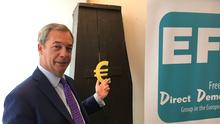
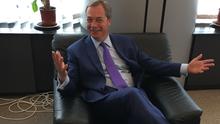
Nigel Farage is sitting in a black leather armchair in his European Parliament office in Brussels. In front of him is a glass table, and next to him is a coffin. The casket, with a large euro sign stuck to the front, has been standing there next to his desk for years. The symbolism is impossible to miss. For the last 20 years, Farage has been fighting against the EU and against the euro. He would like to bury both – which is why he ran for European Parliament as a member of UKIP, his party.
Farage’s mission is to destroy the EU from within. He was the face of the Leave campaign, which ultimately led to the successful Brexit referendum last year. As head of UKIP, he was an instrumental public figure in convincing the British public to vote in favor of the country’s historic exit from the EU.
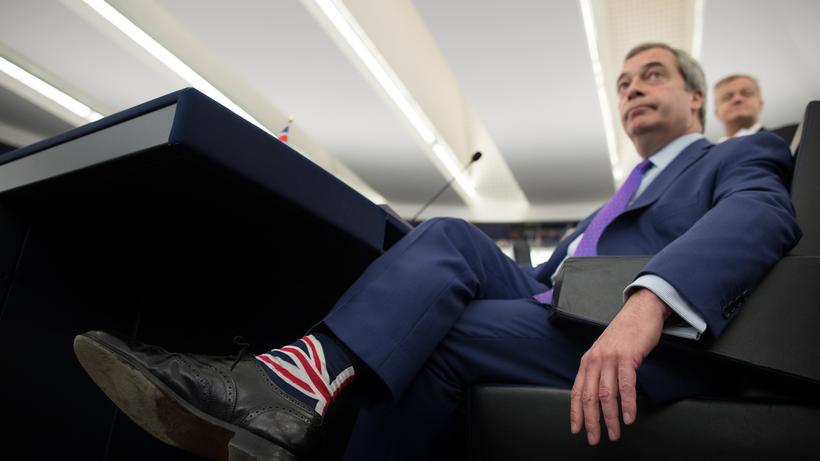
Along with David Cameron and Boris Johnson, Farage is one of the key initiators of Brexit. To demonstrate as much, he put on his United Kingdom socks for the day of our interview. The Union Jack is clearly visible between his suit pants and his shoes. “Proud. Ohh, I don’t know about proud.” But he does say at the beginning of the interview that he is amused by the incipient Brexit negotiations. The interview was organized by his press spokesman, who is also present.
ZEIT ONLINE: Mr. Farage, parliamentary elections are to be held in your homeland in just a few weeks. Why are you sitting here in Brussels in your British socks instead of helping out with the Brexit negotiations back home?
Nigel Farage: If the British government had asked me to help them in any way with Brexit, I would have done that. But of course, they wouldn’t. They will always hate me. They will always see me as an outsider. They will never forgive me for being successful. I don’t mind.
ZEIT ONLINE: What is your role here in European Parliament?
Farage: In some ways, I am one of the pan-European political figures there are here. I am well known in every European country. And actually, Euro-skeptic groups in some way see me as the grandfather of Euro-skepticism.
ZEIT ONLINE: You see yourself as pan-European? How can you fight against something that you yourself embody?
Farage: That’s ironic. I know.
ZEIT ONLINE: Since 1999, European Parliament has paid your salary as a representative. Why do you accept money from an institution that you want to destroy? How can I explain that to my eight-year-old daughter?
Farage: You tell your daughter that a wave of insanity overcame the political classes of Europe. Europe is not the EU. It’s not about a flag. It’s not about an anthem. It’s a totally false creation. I am working for a real Europe, one that does not attempt to take away from individual member states the nationality, the identity.
ZEIT ONLINE: You don’t look like you have lost your British identity.
Farage: We British are not allowed to have our own foreign policy. We are not allowed to have our own trade policy. This is not Europe. We have to break this down. Britain is just the start. The EU is dying. The whole project is finished. It’s dying, it’s dying.
ZEIT ONLINE: Do you still remember June 23, 2016, the day that Brexit was passed?
Farage: It was one of the best days of my life. Oh yes, in my career, it was the best day ever. After all these years of trying and after all these years of being lonely, it was a big day.
Farage is now in his element, saying things that he repeated hundreds of times during the Brexit campaign last summer. Prior to the campaign, Farage faced accusations that he had misused EU funds. According to a story in the Times, the EU paid almost 60,000 pounds to his personal bank account although some of the money had been earmarked for the upkeep of his parliamentary office not far from Littlehampton. That office, however, was in a house that Farage, as head of the UKIP party, had been allowed to use free of charge. After the Times reported on the inconsistencies, Farage threatened the paper with legal proceedings and levelled accusations against the journalists. He denied that he had done anything improper. As a result of the affair, it came out that Farage and other MEPs from UKIP had only begun filling out EU transparency reports, including for the reimbursement of office expenditures, in 2009.
ZEIT ONLINE: Who financed your Leave campaign?
Farage: Who financed the whole Remain campaign for over 50 years? The government.
ZEIT ONLINE: You didn’t answer the question.
Farage: Individuals. Individuals from the UK.
ZEIT ONLINE: And with money from Russia?
“It Was a Private Meeting with Assange”
Farage: No Russian money at all. That’s ridiculous. What you are talking about is conspiracy. I never received a penny from Russia. I wouldn’t have taken it, even if it had been offered. This campaign wasn’t about money. It was about messages, good clear messages.
ZEIT ONLINE: Have you ever received external money for your political work?
Farage: No, of course not.
ZEIT ONLINE: You never received any money for your appearances on Russia Today?
Farage: Which I do twice a year. Or three times last year. I am doing global media. I am talking to you as well.
ZEIT ONLINE: Why did you meet with Julian Assange in the Ecuadorian Embassy in London?
Farage stops for a moment to think. Following his visit to the Ecuadorian Embassy not long ago, he told reporters directly after his meeting with Assange that he could no longer remember what he had done in the embassy.
Farage: Oh, for journalistic reasons.
ZEIT ONLINE: What? Because you want to write a story about the WikiLeaks founder?
Farage: For journalistic reasons. I will not say anything more about that. But I did it for journalistic reasons, not for political reasons.
ZEIT ONLINE: What do you mean when you say, “journalistic reasons?”
Farage: I will not say anything more about that. If you look at what I do today, I used to do politics 100 hours a week. But now I do politics for 40 hours a week, so I have got a lot of time to do other things. I am a Fox News contributor. I am an LBC presenter. I write.
ZEIT ONLINE: You have transformed yourself from a politician to an entertainer?
Farage: Perhaps.
ZEIT ONLINE: Entertainers tend to be paid well for the job.
ZEIT ONLINE: So you were sent by someone to speak to Julian Assange? What did you talk about?
Farage: It has nothing to do with you. It was a private meeting.
ZEIT ONLINE: You just said it was a journalistic meeting, for the public.
Farage: Of course.
ZEIT ONLINE: Are you going to publish an article soon about your connections to WikiLeaks and your meeting with Assange?
Farage: You will have to wait and see. I meet lots of people all over the world. I always help them.
“As a Political Operator, Putin Was the Best in the World”
ZEIT ONLINE: You once said you admire Russian President Vladimir Putin.
Farage: In 2013, as a political operator, he was the best in the world. Yes, this is what I said. But I wouldn’t like to live in his country. I didn’t like a lot of things he did. But as a political operator, he is to be admired.
ZEIT ONLINE: One of Russia’s foreign policy goals is dividing and weakening the EU. Could it be that in the case of Brexit, you were directly or indirectly used for this Russian goal?
Farage: It is obvious that the EU wants to expand to the east and threatens Russia. That’s completely mad.
ZEIT ONLINE: What you say isn’t true. It wasn’t the EU that triggered the revolution in Ukraine, but the Ukrainians who wanted better relations with the EU.
Farage: I want the EU to be destroyed and it doesn’t matter if God or the Dalai Lama wants it was well. The EU is an anti-democratic, failing structure. You know, you are the first person who has asked me if Russia supported me. Maybe you have a special German mindset. No other journalist in the world has asked these questions.
ZEIT ONLINE: I just want to understand your role.
Farage: We have no links to Russia.
ZEIT ONLINE: You didn’t meet with the Russian Embassy’s deputy chief-of-mission in London?
Farage: Ah, hang on. He came to the EP office. Or I met with him in London. So what?
ZEIT ONLINE: Why did you meet with him?
Farage: I think you are a nutcase! You are really a nutcase! Brexit is the best thing to happen: for Russia, for America, for Germany and for democracy. And that’s the key point.
Farage’s press spokesman again interrupts the interview. He says that the interview should focus more on trade relations between Germany and the UK. Farage nods.
ZEIT ONLINE: The United Kingdom’s economy, along with the economies of the remaining EU countries, will be weakened by Brexit.
Farage: What you are saying is complete rubbish. The idea that the EU is good for the economy is absolutely rubbish. The EU is a failing model.
ZEIT ONLINE: Since when have you been convinced of this fallacy?
Farage: Since 1990. Back then, I decided that the whole thing is nonsense. It will never work. It took a while, but now we have left. And we are the first ones. Others will leave as well.
ZEIT ONLINE: Who?
Farage: We will have to see. Greece. But it could be Denmark or Sweden. We will see.
“You Should Be on a Comedy Show”
ZEIT ONLINE: Greece had that option during the financial crisis, but decided against it. Now that Brexit has come to pass, what are you actually? Are you a journalist or a politician? What is your role?
Farage: Changing public opinion. That’s what I have been doing for 20 years. Using television, media. Shifting public opinion. That’s what I am good at.
ZEIT ONLINE: And that’s why you had to meet with Julian Assange?
Farage looks to his press spokesman and pauses again.
Farage: That, that is a different angle in this.
ZEIT ONLINE: It’s an angle that I want to understand.
Farage: Well, you will not get it. I went to meet him very briefly. We talked about a lot of things.
ZEIT ONLINE: But you didn’t want to be seen going into or out of the embassy? Your visit was only publicized because somebody took a picture of you.
Farage’s press spokesman interrupts the interview for a third time. He says that Farage should talk about the economy of the United Kingdom. Farage picks up the phone to make a quick call before continuing to speak.
ZEIT ONLINE: You are a citizen of the United Kingdom?
Farage: Yes.
ZEIT ONLINE: In the event of a hard Brexit, you may not be able to work in Brussels or fly to Hamburg without a visa.
Farage: Before 1914, there were no passports at all. So what are you talking about? You obviously don’t know history, do you?
ZEIT ONLINE: Among the EU’s fundamental principles is the freedom of movement for goods, services, capital and people. Those who leave the EU risk losing these freedoms.
Farage: When I was elected in 1999, borders and immigrants weren’t even mentioned. Not once in my literature. Why? Because it wasn’t relevant.
ZEIT ONLINE: Yet Brexit could result in there being a new border in Europe.
Farage: You are away with the fairies. You must be mad. I have never heard anything so immature in all my life. Because of Brexit I will lose my option to travel to Hamburg? You should be on a comedy show, not be a journalist.
Farage’s press spokesman interrupts the parliamentarian for the fourth time. It’s too much, he says and indicates to Farage that he should put an end to the discussion. Farage stands up from his leather armchair and sits down at his desk. That’s it, he says, and looks at the papers lying in front of him. The interview is over and his press spokesman requests that the journalist leave the room.
Ukip’s finances have always lacked transparency and it has been believed by many that literally £Millions have been syphoned off into private accounts, for instance a sum of over 50% of the costs of Nigel Farage’s office expenses which ran to £100s of £1,000 was listed in one year as ‘sundry expenses’ yet although jhis office manager provided accounts to trial balance Nigel Farage paid an accountant to rejig the accounts – for that he paid £6,000!
Then there was the Ashford Call Center, described by Farage as Ukip’s most profitable fund raising exercise – yet less than 15% of the money raised ever reached Ukip’s bank account – at that time about £1/4 Million was paid into an Eastborne bank account and approximately the same amount was paid into one of Nigel Farage’s off shore bank accounts in the tax haven of The Isle of Man, into the account called ‘Farage Educational Trust’.
Nigel Farage, who you will recall, no doubt, worked at one time for a French Bank in London and also as a trader for Refco (where a large number of senior employees wound up in prison), he alsao ran his own business for a while as a Metals Trader – yet he lied to the media and said he didn’t realise that that account he had in the Isle of Mann was held in a tax haven! He also claimed never to have used it, I would call £1/4 Million fairly substantial use! That he considered it an insignificant amount in an insiognificant account gives pause for thought as to which of his accounts he considers significant and just how large a sum is significant!
It is also worth following the money trail behind his present sponsor and ascertainiong where his money comes from, a start to your research may well be found at:
Aaron BANKS, (sometimes Aron) Fraser Andrew – something of a roundup to 28-Feb-2017 CLICK HERE also see HERE
I try to make every effort to NOT infringe copyrights in any commercial way & make all corrections of fact brought to my attention by an identifiable individual
e may well find the US Special Prosecutor appointed to investigate Team Trump’s links with Russia will expose more of the sourcing of the funding of Aaron Banks and Ukip over the years!
Has Ukip been prostituted for money all along, hence the low caliber of its leadership team and senior elected members?
KGB-REXIT?
Wikileaks: Inside the Farage-Assange-Trump Connection
How Donald Trump’s best friend in Britain—another big fan of Vladimir Putin—put his party at the service at Wikileaks’ Julian Assange.
LONDON—When Julian Assange sought refuge in 2011 at an embassy in the heart of London, only one of Britain’s political parties was willing to offer support to the exile in their midst.
Nigel Farage’s U.K. Independence Party, which seemed a fringe movement at the time but became the driving force behind Brexit, swung into action and campaigned against the demand that Assange be returned to Sweden for a police interview on allegations of rape.
The episode raises further questions about links between Farage, Assange and the Russian government. Farage, who is also a favored friend of U.S. President Donald Trump, was spotted emerging from a meeting with Assange at the Ecuadorian embassy in March.
Internal UKIP memos reveal the relationship went back much further: Assange and his lawyer were given the opportunity to contribute directly to speeches given by UKIP on the floor of the European Parliament while branches of the party in and around London were told to send activists to protest against Assange’s proposed judicial surrender to the authorities.
“We need bodies,” read an email request sent to local UKIP associations asking them to send two or three people each as an “astroturf” protest against Assange’s plight when he appeared in court in London in January 2011.
Stephens was asked if he or Assange would like to meet a UKIP member of the European Parliament, Gerrard Batten, on January 31 that year “in order to discuss bringing out issues in the case.” He was asked again if he wished “to include a few points to get the message across” on February 5, 2011, before Batten was due to speak in the European Parliament. Batten asked Stephens again if he had “any points that you feel I should or should not mention in the few minutes I get to speak” on February 11.
Batten addressed the European Parliament, standing at Farage’s right hand, on February 14, 2011,. where he raised the prospect that Assange was being mistreated because he was “a political dissident.” He returned to the case in June 2011, telling the parliament in Brussels that the U.S. “need him locked up somewhere” while they work out how to prosecute him.
The UKIP MEP also made a submission on behalf of Assange in his case against extradition, which went all the way to Britain’s Supreme Court in 2012. Last year, Batten wrote on his blog that Assange’s stay in the embassy of Ecuador had been tantamount to “arbitrary arrest and imprisonment.”
When news broke on Friday that Sweden would no longer pursue the allegations against Assange after a seven-year standoff while he hid in an embassy out of the reach of British law enforcement, Batten told The Daily Beast he had never taken a position on the guilt or innocence of Assange.
“I don’t really have a view about Mr. Assange. My involvement with him was regarding my opposition to the European Arrest Warrant,” he said. “At the time, eminent British lawyers who looked at it said this would never make it to an English court—these kind of accusations. It didn’t sound very sound in the first place.”Assange hailed Sweden’s decision to stop pursuing the allegations and celebrated the release of Chelsea Manning—one of the first major WikiLeaks leakers—in a speech from the balcony of the embassy in London’s Mayfair.
“We have today won an important victory, but the road is far from over. The proper war is just commencing,” he said, promising to accelerate the distribution of material about the CIA. The standoff will continue because there is still an outstanding warrant for Assange’s arrest over skipping bail.
Batten told The Daily Beast he had attended Assange’s lavish 40th birthday party in 2010 but had not met with him since. He said he does not recall whether Stephens or Assange took up his offer to help with his speeches. He also said he had received no donations from anyone connected to WikiLeaks or the Russian government. “If only these people would offer me money, I’d have the luxury of refusing it,” he said.
UKIP has repeatedly denied co-operating with Russia, Russian front organizations, or taking funds from the Kremlin—which would be illegal under British law—but Farage, who was one of the first foreign politicians to meet with Trump after his election, has called for improved relations between Russia, Britain, and the U.S. He also described Vladimir Putin as the foreign leader he most admires.
Last week, Farage refused once again to answer questions about his recent visit to see Assange in the Ecuadorian embassy in London. “That has nothing to do with you,” he snapped at a Die Zeit reporter. “It was a private meeting.”
He has claimed that he met Assange as a journalist—not as a political go-between—but no interview has appeared since the March 9 meeting.
In the same interview, Farage also failed to disclose whether he received payments for his regular appearances on RT, a news channel funded by the Russian government, which paid Assange to produce his own show in 2012.
Farage has denied that he was carrying a secret message to or from Assange, whose WikiLeaks organization has been accused of influencing the result of last year’s U.S. presidential election with the help of Russian hackers.
One of the UKIP candidates contesting Britain’s election next month told The Daily Beast that there is nothing suspicious about the attitude towards Russia taken by Farage and his party. Nigel Sussman, the parliamentary candidate for Edmonton in North London, says it’s a natural meeting of minds.
“Russia is very credible and commonsensical—and UKIP is very credible and commonsensical,” he said. “There’s a synergy of views there.”
Sussman has a more intimate view of Russia than most British politicians. He traveled to Crimea last month as a guest of the Russian parliament, who paid for internal flights, accommodation and food. Sussman says he paid for his own round-trip flights to Russia.
Sussman, the chair of UKIP’s Ilford association, who was on the trip with another former UKIP candidate, met with the local pro-Russian officials and toured the streets of former eastern Ukraine talking to local residents accompanied by cameras from Russia’s state-owned TV Channel 1. Although most of the international community regards Moscow’s covert occupation and annexation of Crimea following as stage-managed vote as illegal and illegitimate, based on his interviews, Sussman says: “Crimea had a perfectly legitimate referendum in my opinion.”
As a result, he has submitted a report to UKIP’s National Executive Committee, which calls for a policy change—demanding that sanctions should be lifted against Russia.
“As far as I can see there don’t seem to be a lot of people standing up for Russia right now,” he said. Is UKIP the most pro-Russian party? “Yes, I think it is.”
Sussman is, however, hopeful that Trump will ease relations between Moscow and the West. “I have high hopes for Trump because Trump is going to meet Putin. I think he has said it plain: he wants to be friends with Russia. That sounds like an eminently sensible position for God’s sake!”
The UKIP candidate insisted that there was no evidence that Putin’s regime had helped Trump into office, although the U.S. intelligence community is on the record and unanimous in its conviction that Russia tried to influence the outcome. He also explained away Moscow’s reported munificence towards Marine Le Pen. “What happened was Le Pen tried to get a loan from French banks and none of the French banks would lend her any money—and that’s outrageous… It’s a bit like UKIP, I mean God help us!”
The bottom line: Le Pen’s party received millions of dollars in loans in 2014 from a now defunct Russian bank, and, whether coincidentally or out of conviction, her minions, too, endorsed the Crimean annexation.
The two representatives from Britain on the Crimea tour this year were not joined by any members of Le Pen’s National Front, but the guests included an unlikely array of minor party politicians like Jaroslav Holik from a Czech party with links to Le Pen, or the son of Serbia’s Vojislav Seselj, who was acquitted of war crimes and crimes against humanity by a United Nations tribunal in the Hague.
“It’s a collection of odds and sods; far left or far right will do, as long as they are open to some Russian support. Some of these are full Russian puppets like the Serbian Radical Party,” said Neil Barnett, the chief executive of Istok Associates, a corporate intelligence and investigations consultancy.
Arron Banks, the British businessman who was once UKIP’s biggest donor and set up the unofficial Brexit campaign group Leave.EU, says he has a good relationship with Russia—including long boozy lunches with the Russian ambassador—but says there has been no monetary donation either directly or through his array of offshore companies.
Banks, who was pictured in the entourage that met Trump with Farage in the days just after Trump won the election, gave an extraordinary interview to the Observer newspaper in London last month in which he admitted that his Russian wife had the profile of a Russian spy, then suddenly denied that Russia had bankrolled Brexit—unprompted—and repeatedly defended Putin.
“What you’re talking about is the degree to which the Russians actually—let’s say they influenced the Brexit vote. Say I’m pro-Putin. Nigel said he’s not anti-Putin, if that’s the right word. But all we’ve said is that there are elements of what Russians do that we don’t disagree with. We don’t agree with everything they’re doing, like murdering journalists in the street,” he said.
This “joke” is typical of Banks, who ensures it’s hard to know exactly how seriously his words should be taken at any given moment.
When his old pal Farage was spotted leaving the Ecuadorian embassy in March, original reports said it was unclear why he had been inside the building—not least since Farage claimed to have forgotten.
A newspaper later reported that he had indeed been holding secret talks with Assange, and Banks wrote on Twitter: “Well he didn’t go for drinks with the ambassador did he?”
Another multi-millionaire with loose-lips, like Trump, Banks seems to revel in offering glimmers of a sprawling axis that runs from Washington D.C. to Moscow via London—and a tiny sliver of Ecuadorian sovereignty.
Whether Assange makes it outside the embassy in the coming days or if he continues to hide from justice—the game of shadows will continue.
I try to make every effort to NOT infringe copyrights in any commercial way & make all corrections of fact brought to my attention by an identifiable individual





 Greg Lance - Watkins (Greg_L-W)




 ~~~~~~~~~~#########~~~~~~~~~~


 Ukip-vs-EUkip